BONE REGENERATION
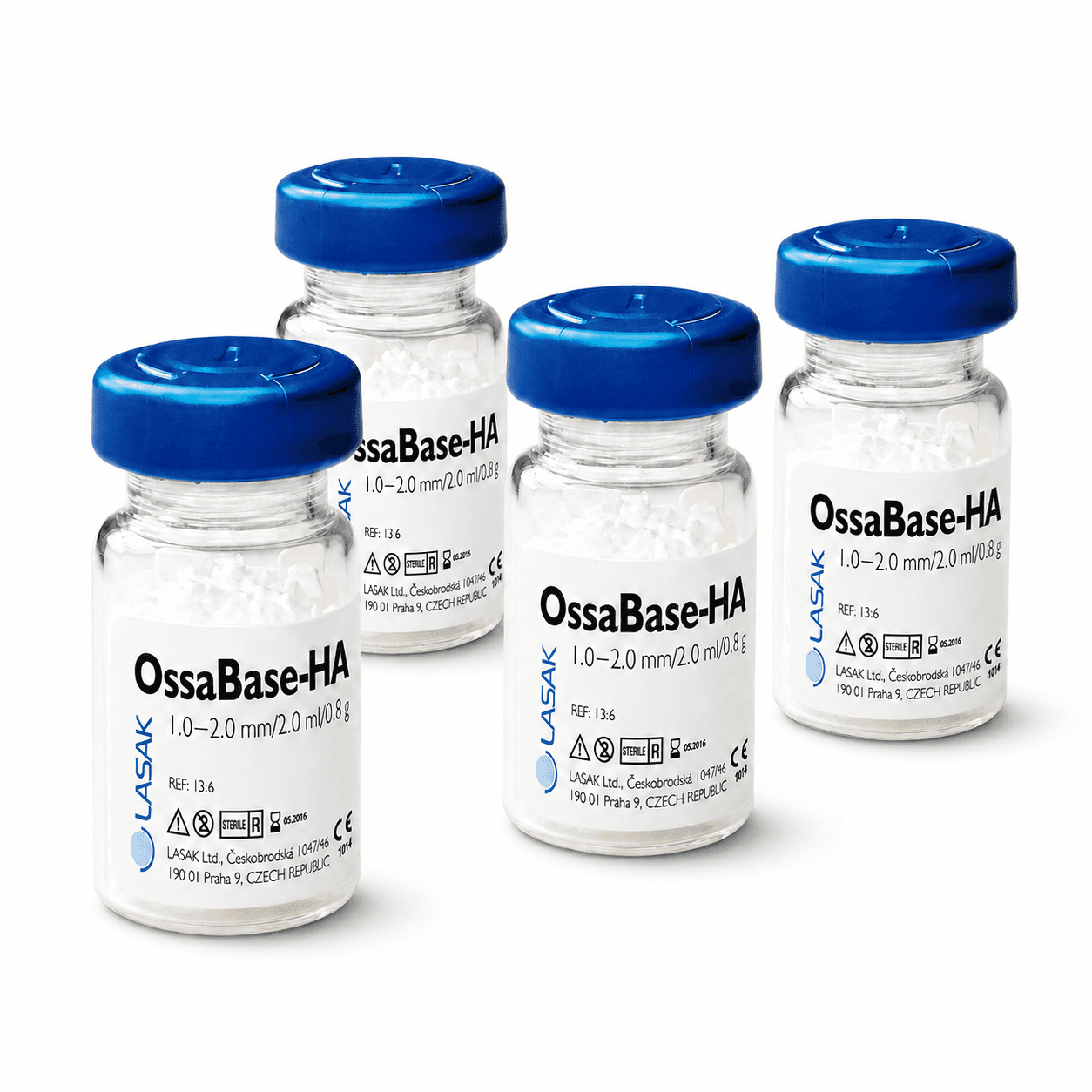
OssaBase-HA
Synthetic, macro- and nanoporous bone graft material based on hydroxyapatite. High osteoconductivity, no organic components — a safe choice for long-term implant stability.
From €30 excl. VAT.
0%
Interconnected porosity — mimics natural bone structure
0
Available product variants
0%
BIC (bone-implant contact) after 3 months
Key Characteristics
Designed for optimal bone regeneration
Macro- and nanoporous structure
Interconnected macropores and nanopores precisely mimic the architecture of natural bone tissue, optimally supporting vascularization and cell ingrowth.
Low resorption rate
The slow resorption rate provides long-term support of the augmented site and promotes implant stability during osseointegration.
High phase purity
Pure hydroxyapatite phase without organic additives guarantees maximum biocompatibility and predictable clinical outcomes.
High osteoconductivity
The material actively guides ingrowth of new bone tissue into its pores and creates a strong bond with surrounding bone without organic components.
Safety — no transmission risk
Fully synthetic origin eliminates any risk of immunological reaction or pathogen transmission — no animal or human components.
Nanostructured surface
The nanostructured granule surface facilitates preparation of the bone bed for later implant placement and improves osteoblast adhesion.
Applications
Clinical Indications
OssaBase-HA is indicated for a wide range of dental, oral-surgical, and orthopedic procedures where bone tissue replacement or augmentation is required.
- Implantology — alveolar ridge remodeling
- Periodontology — treatment of periodontal defects
- Sinus lift — subantral augmentation
- Post-extraction socket preservation
- Orthopedics — treatment of bone cysts and benign tumors
- Traumatology — post-traumatic and pathological defects
Histological findings
Clinical data
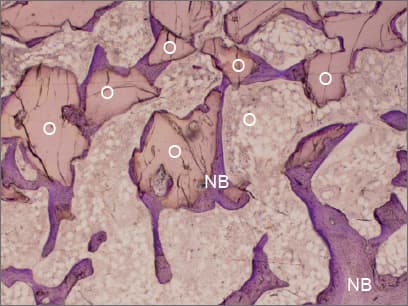
New bone formation (NB) on OssaBase-HA particle surfaces (O) at the spongy site of the surgically created bone defect.
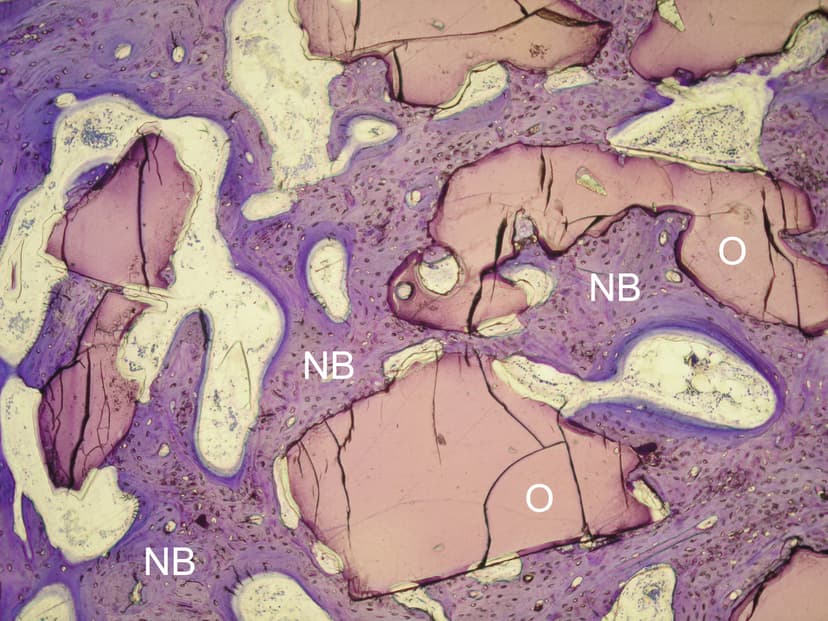
Fragments of the OssaBase-HA material are tightly surrounded by vital, newly formed bone (NB), which also fills the macropores of the material (O).
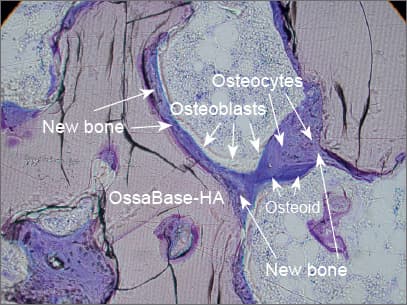
High magnification image of OssaBase-HA implant showing that new bone (NB) has formed around the implanted granules. Notice the bone bridge that connects the granules. Arrows indicate the osteoid layer at the periphery of newly formed bone. Note the central osteoid area in the case of replacing the thinner and longer bone bridge.
Scientific Data
Specific Surface Area Comparison
OssaBase-HA achieves an exceptional specific surface area
The specific surface area of the material directly influences biological activity, protein adsorption, and cell ingrowth. OssaBase-HA with a value of around 73 m²/g significantly outperforms other synthetic materials on the market and achieves results comparable to Bio-Oss®.
- Higher specific surface area = better growth factor adsorption
- More intensive osteoblast ingrowth into the material
- Comparable results to Bio-Oss® with fully synthetic origin
- Histologically confirmed: 73% BIC after 3 months
Source: Specific surface area comparative study (BET analysis) — LASAK s.r.o.
Product range
Available variants
| Catalog Number | Grain Size | Package |
|---|---|---|
| 15:6 | 0.3–0.6 mm | 0.5 ml / 0.25 g |
| 13:6 | 0.3–0.6 mm | 1.0 ml / 0.5 g |
| 25:6 | 0.6–1.0 mm | 0.5 ml / 0.25 g |
| 23:6 | 0.6–1.0 mm | 1.0 ml / 0.5 g |
| 43:6 | 1.0–2.0 mm | 1.0 ml / 0.4 g |
| 40:6 | 1.0–2.0 mm | 2.0 ml / 0.8 g |